


Minishoot' Adventures Review: Small But Mighty | The Gamerheads Podcast


Platform reviewed: Nintendo Switch 2
Also on: PC (Steam), Nintendo Switch, PlayStation 5, Xbox One, Xbox Series X/S
Price: $15.99
There are a few times when a game really captures my attention to the point where all I think about is the game and what I’m going to do next. Minishoot’ Adventures is one of those games. It recently released on the Nintendo Switch 2, and it’s a perfect fit for the system; it feels like a game inspired by Nintendo classics like The Legend of Zelda and Metroid. I haven’t had this much fun with a game in a long time. Maybe it’s because it harkens back to when I was a kid playing those classic Nintendo games. It definitely scratched an itch I didn’t realize was there.
One of the most overslept games in recent history
Minishootin’ Adventures originally released a few years ago. Shame on me for not knowing about this game before its release on the Nintendo Switch. My friend, Mike Towndrow from Six-One Indie, said it best when he commented that it's the most overslept game in recent history. It’s a top-down twin-stick shooter, and that’s what initially caught my attention. I love the genre, and for some weird reason, I also love bullet hells. Minishootin’ Adventures certainly offers both, but it’s much more than just an arcade-style shooter.
For starters, there’s a story to the game. An evil corruption has returned and taken my friends (other spaceships) captive. The ship I play as awakens from a dark crystal, and I set out to search for my friends and save them while getting rid of the corruption that has spread across the world.
The main protagonist in the game is adorable
I didn’t realize how much personality could be brought to life in a spaceship, but the main protagonist in the game is adorable. Whenever I flip over an obstacle or zip away from an incoming projectile, my ship makes a cute little beep and has a small animation that really brings it to life. It’s weird to call the ship a character. Normally, any vehicles I drive don’t have much personality, outside of Transformers, but it didn’t take long for me to start seeing it that way. It’s small, but mighty.

But it’s not just the main character that stands out. The ships I rescue are also full of personality, whether they’re selling me goods, healing me, or providing upgrades. Most of these upgrades come at a price, of course.
The game opens with me escaping from my chrysalis and navigating my way out of the first dungeon. Minishoot’ Adventures does a nice job walking me through the basics, as this dungeon acts like a tutorial. Shooting and moving are pretty straightforward, and anyone who has played a twin-stick shooter will pick up the basics quickly. But as I continue exploring, I start to realize the game doesn’t hold my hand and instead lets me explore the open world any way I want.
One of the best things about Minishootin’ Adventures is how much it leans into my curiosity
Minishoot’ Adventures is open world, but there are areas I can’t access until I get certain upgrades for my ship. I’ll come across a section blocked by a body of water and immediately think there must be a way to fly over it. I see torches that need to be lit, and I instinctively realize I need something to light them. Nothing in the game flat-out tells me what to do or where to go next, but there are plenty of clues that point me in the right direction.
I don’t have the ability to make any notes or place icons on the map, but the game fixes that with an unlockable. I find a ship/bot that reveals parts of the map as I collect map pieces throughout the world. There’s also an item I can purchase from another bot that adds a checkmark to dungeons once I’ve fully uncovered everything. This is probably one of the most helpful items I’ve picked up, as I’ve gone back to areas I thought I had fully explored, only to realize I missed something, usually because I didn’t have the right weapon or item yet.

One of the best things about Minishootin’ Adventures is how much it leans into my curiosity. Even if I don’t have the map pieces for an area, I can still go out and explore. There were plenty of times where I saw something and thought, “what is around this corner?”
Outside of needing a specific item or ability to get past certain obstacles, most of the game lets me wander off, find a hidden cave, and dig deeper into this world. And the world feels massive. I’ll come across a cave filled with ancient statues and wonder what they’re for. I’ll find broken-down ships in the desert and think, “are these from another civilization before my time?”
In a lot of ways, Minishootin’ Adventures reminds me of a The Legend of Zelda game, but with a sci-fi twist instead of a fantasy setting. The game pulls me in just enough before I hit a wall and realize I’m not supposed to be there. Not yet, anyway.
There are a few types of currency in the game. Red tokens are dropped from larger enemies and bosses, and I use them to purchase upgrades for my ship or special items, like better guns that fire more bullets at a time, or the map device I mentioned earlier.
There are also fireflies that I can trade to a bot I rescued to upgrade my special abilities or unlock heart container pieces. Then there are red crystals, which fill up a container. These drop from every enemy or can be found in piles throughout the world. Once the container is full, I earn a point that I can spend on leveling up my ship.
Upgrades include things like firing faster, shooting farther, or moving faster. The more I level something up, the more it costs for the next level. This made the game feel more like an RPG, and I found myself grinding for red crystals a few times to level up certain abilities. However, I can also downgrade any upgrade at any time and respec my ship. It’s a clever way to let me create a build that fits my playstyle.
There were a few times when I thought I had beaten a boss, only to realize they had another stage I needed to get through
The boss battles are some of my favorite parts of the game. Each boss dungeon has certain doors that are locked by keys, along with a final idol piece that I need to find to open the path to the boss. Unlike the overworld, there are no maps for the dungeons, which is one area where I wish the game had included them.
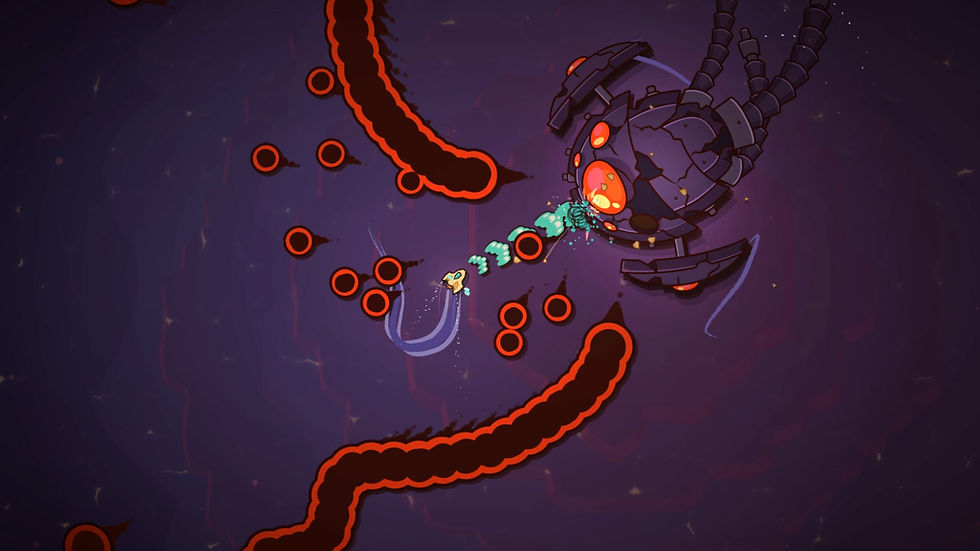
The bosses get progressively more difficult, with multiple stages before they’re finally defeated. There were a few times when I thought I had beaten a boss, only to realize they had another stage I needed to get through.
I also love the level design. Each biome is handcrafted and feels distinct. There are areas like a desert, where a giant enemy ship slithers through the sand with broken ship pieces trailing behind it like a centipede (and no, this isn’t a boss, just a creature that pops out of the sand). In the water world, there’s a giant turtle that I ride to reach the boss area, since I can’t hover over water at this point.

The music stands out as well. The woods have a dream-like quality, while the water areas feel more like an adventure tune. All of this comes together with a beautiful art style that has a retro feel but still looks modern. It’s a perfect fit for this spaceship open world adventure and feels great to play on the Nintendo Switch 2.
Final Grade: A
Minishoot’ Adventures is one of my favorite games on the Nintendo Switch 2. It feels right at home, especially since it clearly takes inspiration from games like The Legend of Zelda and Metroid. It does little to hold your hand, but subtle clues point you in the right direction on where to go and what to do next. There are plenty of hidden secrets as well, giving completionists a lot to explore. If you’re a fan of twin-stick shooters or exploration heavy games like Zelda, Minishoot’ Adventures deserves a spot in your library.
Review copy provided by JF Games


Comments