


Below the Crown Review: Very Meta | The Gamerheads Podcast

Updated: May 10

Platform reviewed: PC (Steam)
Price: $14.99
Chess played out as a dungeon crawler? What a brilliant idea. That’s exactly how Below the Crown feels, a strategy deck builder that combines the tactical depth of chess with elements of roguelikes and dungeon crawlers. It’s one of the most unique games I’ve played in a while, and it gets me thinking on a deeper level, in more ways than just how to defeat the king.

The game opens with a view of a castle. Visually, it feels like I’m stepping into the innards of an ’80s arcade, or at least the behind-the-scenes world of one. It’s almost like I’m seeing what’s happening behind the curtain. The castle walls glow orange with a strange luminescence that feels distinctly old school, like stepping into Tron. I’m not sure if the developers intended to create that sensation of peeking behind the curtain of a game, but other elements throughout Below the Crown gave me that feeling too, and I’ll get to that in a bit.
There’s a brief tutorial where I learn the basics of movement and casting pieces. The first piece already on the board is my king. As in chess, the king can only move one space in any direction. But after moving the king, I can cast a chess piece from my deck. This is where things start to feel different. I can place that piece anywhere on the board, as long as it’s within the king’s line of sight. That opens the door for some really interesting strategies, and instead of simply moving pieces across a board, I feel like I’m actively planning out a battle.
I also learn that the rooms are laid out like a chess grid, but not every room is symmetrical or even evenly sized. Some are small, while others are oddly shaped. For example, one room might be four spaces deep and nine spaces wide, with a two-space nook at the bottom where my king begins. Later, I discover that some rooms include obstacles, like pillars, that block my pieces’ movement. These design choices make each board feel less like a traditional chess match and more like exploring the rooms of a dungeon, which strengthens the game’s dungeon-delving identity.
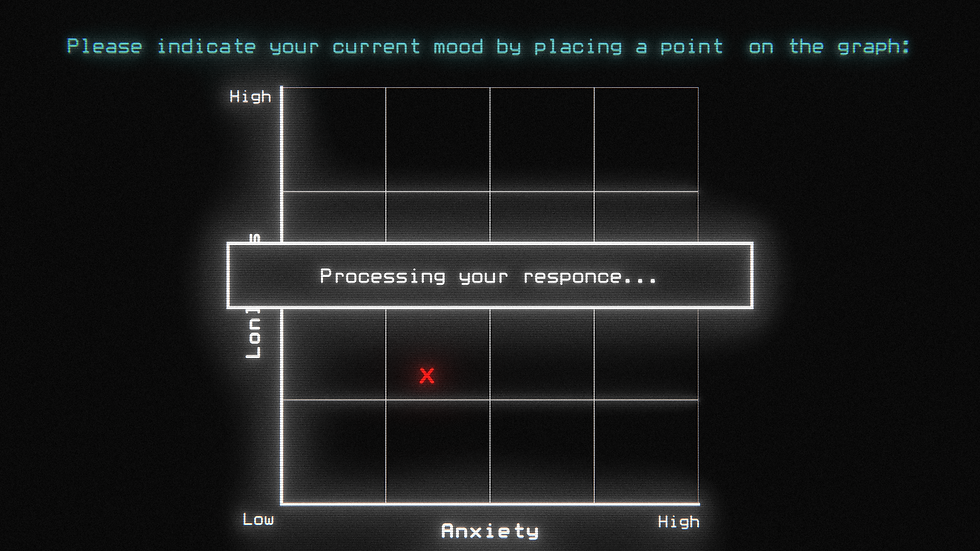
After the short tutorial, I’m asked to indicate my current mood by placing an indicator on a graph. One axis measures loneliness, while the other tracks anxiety. This is where things start to feel meta, and once again, I get the sense that I’m experiencing something behind the scenes of the game, like I’m a test subject in something larger unfolding around me. This isn’t the last time Below the Crown asks me to reflect on my thoughts on something, and each time, these moments are presented in stark white text. That visual choice sharply contrasts with the game’s usual greens, oranges, blues, and yellows, making these sequences feel even more deliberate and a bit unnerving.
After answering the survey, I’m confronted by a shady figure known as the Emperor. He looks like several chess pieces fused together into one dark, menacing form. He asks what I have to offer him. My only option is nothing, because, well, I have nothing to give. The Emperor is displeased and commands me to go deeper. It’s not the last time I encounter him either, as he repeatedly appears throughout my descent, demanding tribute from what I uncover in the dungeon.

As I continue my adventure through the boards, I encounter rooms where I can purchase spells. These include abilities like freezing enemies for a set number of turns or creating slime-covered spaces that prevent pieces from crossing. I also discover rooms that let me upgrade my chess pieces, unlocking abilities like placing them anywhere on the board, even outside my king’s line of sight, or granting them the movement of a rook. I can even create champions and give them their own names, which makes the pieces feel more personal than a generic chess piece.
This isn’t your parents’ chess. While there are familiar pieces like rooks and bishops, there are also unique ones like the prince, who moves similarly to the king, or the archer queen, who can only move one space at a time but can attack from long distances. And as I mentioned before, upgrading these pieces unlocks even more abilities, giving me new strategic advantages against my opponents.
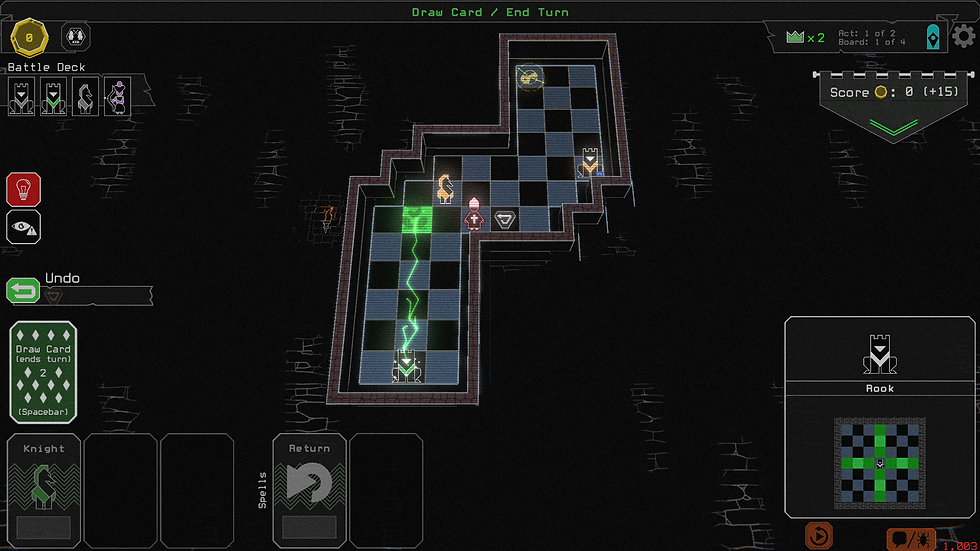
If I make a mistake, I can undo my last move. However, I only have so many undos per run, though I can find additional undo tokens scattered throughout the dungeon. I can also ask for assistance once per room, which I usually try to save for when I truly need it. Boss battles are noticeably more challenging than standard rooms, and I found myself relying on that assistance far more often during those encounters.
The game also doesn’t reward me for taking too long in a room. After a certain number of turns, spaces on the floor begin turning to lava. I’ve actually used this to my advantage, trapping a king on space just before it transforms and watching him fall to a fiery death. It’s a clever mechanic that keeps the game moving while forcing me to make decisions quickly.
Final Grade: A
You don’t have to be a chess expert to enjoy Below the Crown. The game provides enough of a tutorial to help newcomers understand how each chess piece moves. Below the Crown feels more geared toward fans of deckbuilders and roguelikes who also enjoy unraveling a mystery. This is one of the cleverest games I’ve played this year, not just from a gameplay perspective, but because of the deeper, more meta experience unfolding beneath the surface.
Review code provided by Stride PR


Comments